Against the same-window beat baseline of 59% negative, this entity's 78% share is more negative. Each story carries 4 original sources on average, compared with 2.9 for the broader beat in this window. Of the tracked stories, 4 of 9 also mention Anthropic, the most common co-covered peer.
Figures are computed live from our source-verified story record
— see our methodology for how impact and
sentiment are derived.
What the coverage shows about Department of Defense
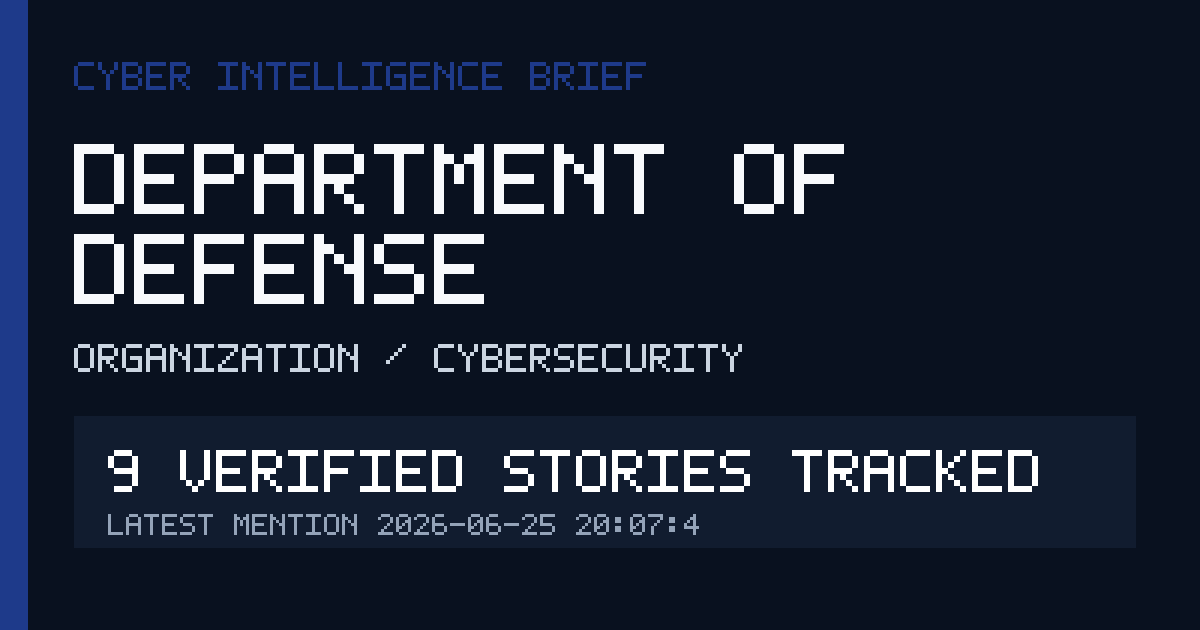
Against the same-window beat baseline of 59% negative, this entity's 78% share is more negative. Each story carries 4 original sources on average, compared with 2.9 for the broader beat in this window. Of the tracked stories, 4 of 9 also mention Anthropic, the most common co-covered peer. The 25-day window averages about 2.5 stories each week. The busiest single day carried 2. Their average consequence score of 7.1 sits level with the 7.1 recorded across the beat in that window. regulation accounts for 5 of the 9 tracked stories, while 2 other categories carry the remainder. Department of Defense appears in 9 tracked Cybersecurity stories published from February 28, 2026 through March 24, 2026.
Stories tracked
9
Per week
2.5
Negative
78%
Sources per story
4
Computed from the 9 stories linked to this entity, with beat comparisons drawn from all 365 Cybersecurity stories published in the same date window. Shares are omitted below five stories and comparisons below a twenty-story baseline.
Coverage cohort
Appears alongside
Other entities that clear the same relevance threshold in stories also covering Department of Defense. Shared-story counts are live from our verified record — not editorial picks.
AI developer Anthropic has initiated legal action against the Pentagon to overturn a 'supply chain risk' designation it deems stigmatizing. The case represents a major clash between national security vetting and the commercial viability of leading AI firms in the federal market.
The United States has initiated a massive deployment of thousands of troops following specific Iranian threats against global tourism sites. This military escalation signals a shift toward hybrid warfare, placing the cybersecurity community on high alert for retaliatory strikes against critical infrastructure and the travel sector.
The convergence of artificial intelligence, hypersonic missile technology, and intensifying geopolitical rivalries is fundamentally altering the global security architecture. This shift necessitates a transition from traditional deterrence models to high-speed, AI-augmented defensive postures capable of countering autonomous threats.
Anthropic has filed a lawsuit against the U.S. Department of Defense after being labeled a supply chain risk, a move that has triggered an unprecedented show of solidarity from nearly 40 employees at rivals OpenAI and Google. The group, which includes Google Chief Scientist Jeff Dean, filed an amicus brief arguing that the Trump administration's designation lacks transparency and threatens the broader AI ecosystem.
AI developer Anthropic has filed two lawsuits against the Department of Defense, challenging a 'supply chain risk' designation that the company claims is ideologically motivated. The legal battle marks a significant escalation in the tension between AI safety-focused firms and the Pentagon's national security vetting processes.
OpenAI's head of hardware and robotics has resigned in protest of the company's expanding partnership with the U.S. Department of Defense. The departure underscores a deepening divide within the AI industry over the ethical boundaries of deploying advanced autonomous systems for military applications.
OpenAI CEO Sam Altman has clarified that the company does not hold authority over operational military decisions regarding its technology. This statement marks a significant boundary-setting moment as the AI giant deepens its engagement with national security and defense agencies.
Q4 2025 earnings reports from key identity and hardware players reveal a significant shift toward "liveness" detection and hardware-rooted security to combat AI-driven spoofing. Companies like Aware and Everspin are securing critical infrastructure through biometric certifications and radiation-hardened memory, signaling a move toward zero-trust physical and digital architectures.
President Trump has issued a directive for all federal agencies to immediately cease the use of Anthropic’s AI technology. The ban follows the company's refusal to modify its safety protocols to enable mass surveillance and the development of autonomous weapons systems.
Department of Defense is linked from 9 stories on this site, each scored at or above our 35% relevance threshold — see how these pages are built.
See something wrong on this page — a misattributed entity, a wrong stat, a broken source
link? Report a data issue.